📄 Digital PDF book · read on your phone or print

Read airspace, weather and charts in one order: drawn first, sourced to the FAA

One big drawing per topic for the FAA Private Pilot written exam, with the altitude, minimum or step right under it. 59 pages in 9 parts.

Price US$ 27 US$ 63

Get the book + 2 free gifts

🔒 Secure checkout · PDF by email · 30-day guarantee

Sources: 14 CFR Parts 61 and 91, the AIM and the Pilot's Handbook of Aeronautical Knowledge

Real pages

A look inside the pages

Under each drawing, a box with the altitudes, minimums or steps you need to remember, and the regulation or handbook they come from.
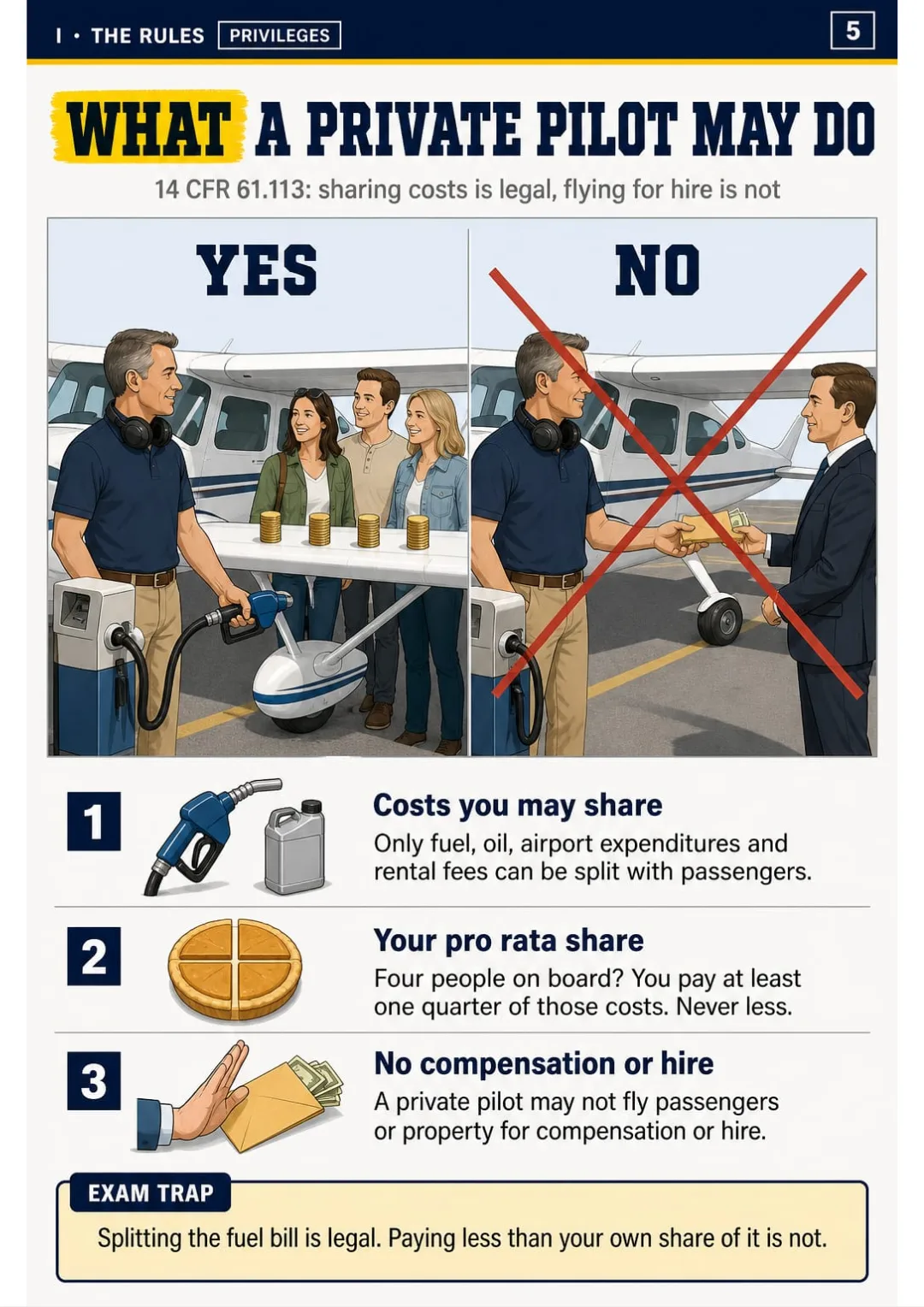
61.113: share fuel, oil, airport and rental costs, but pay at least your pro rata share.
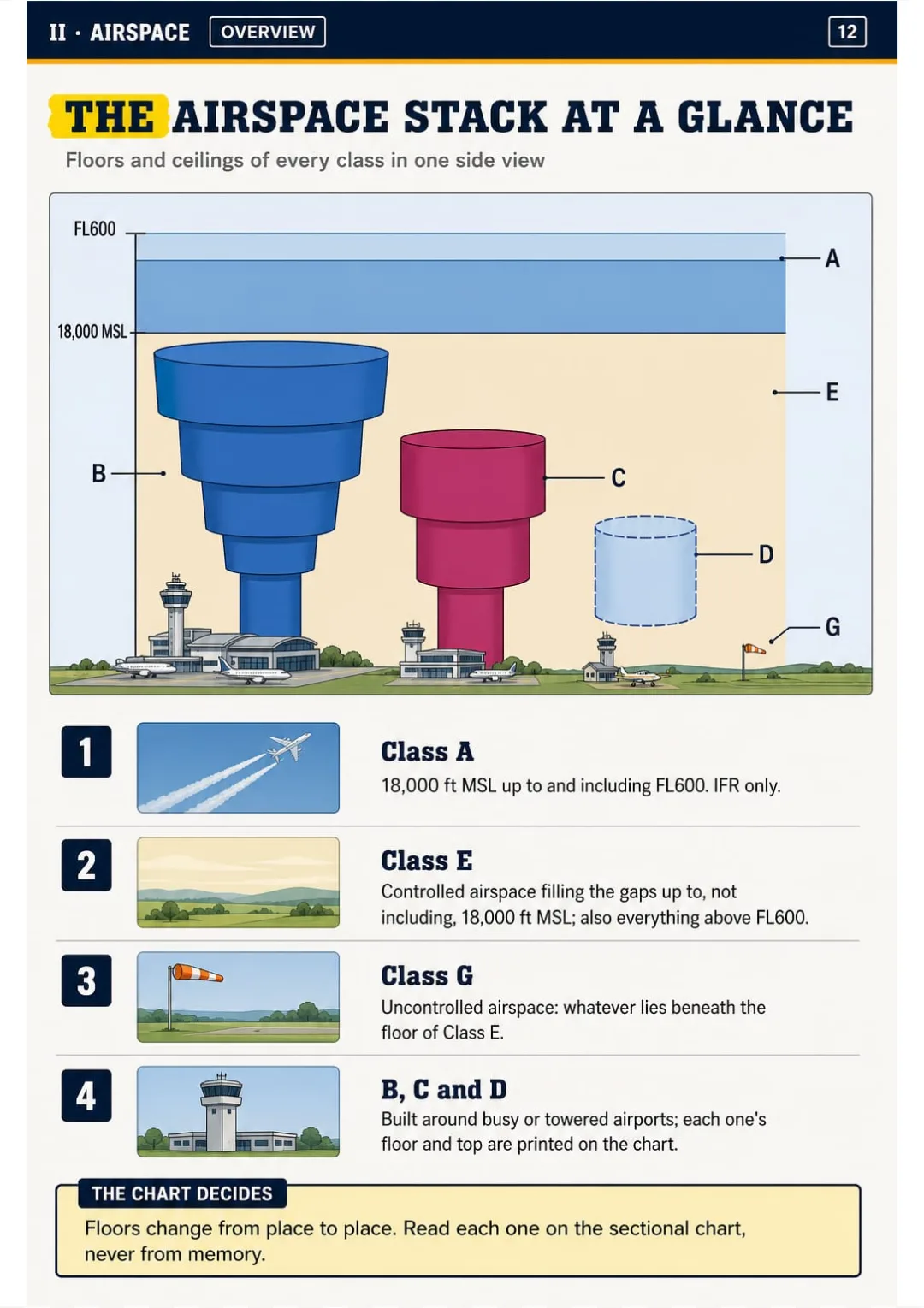
Class A from 18,000 ft MSL to FL600, Class E filling the rest of controlled airspace and above FL600, Class G underneath.
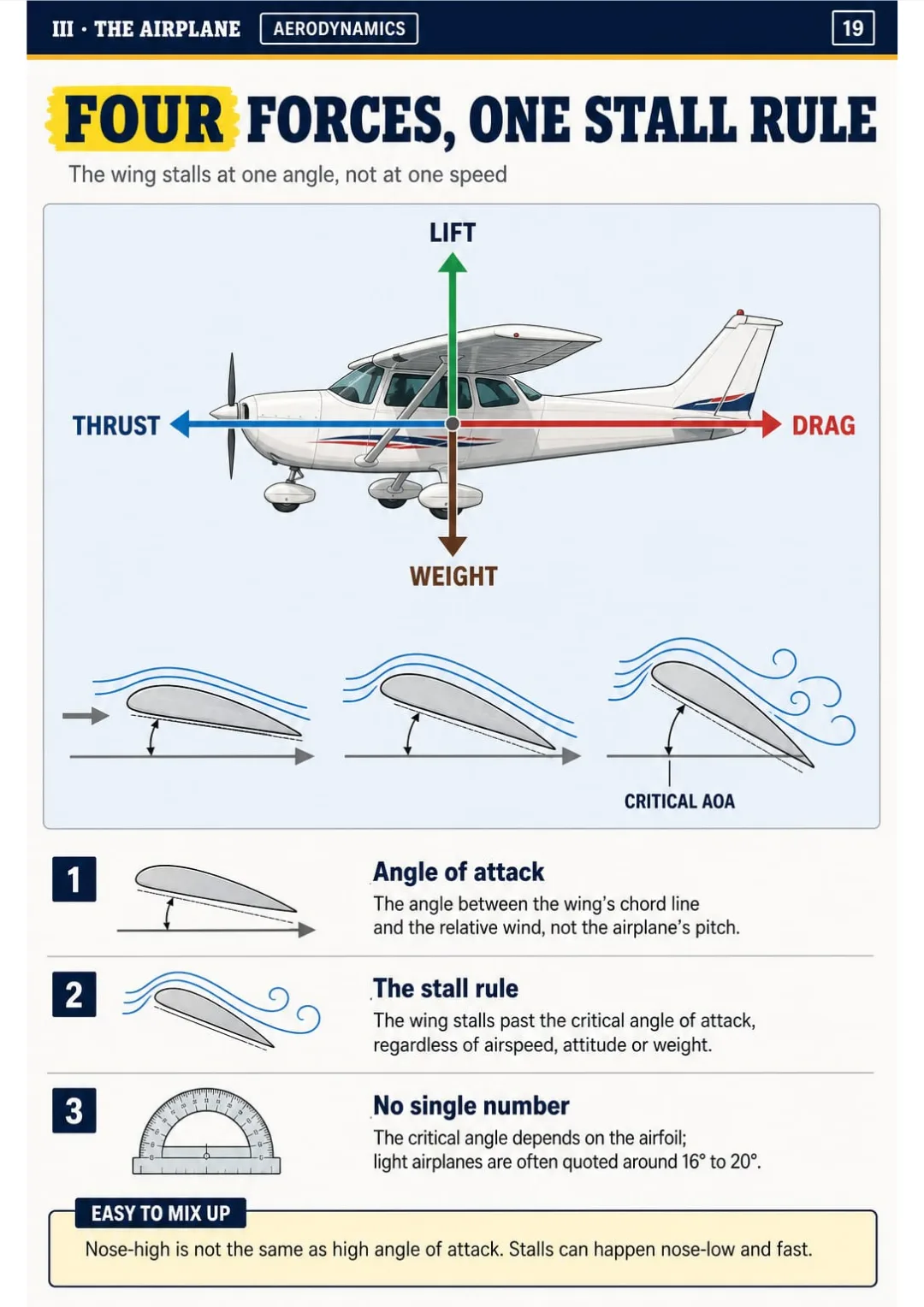
Lift, weight, thrust, drag, and the critical angle where a wing stalls
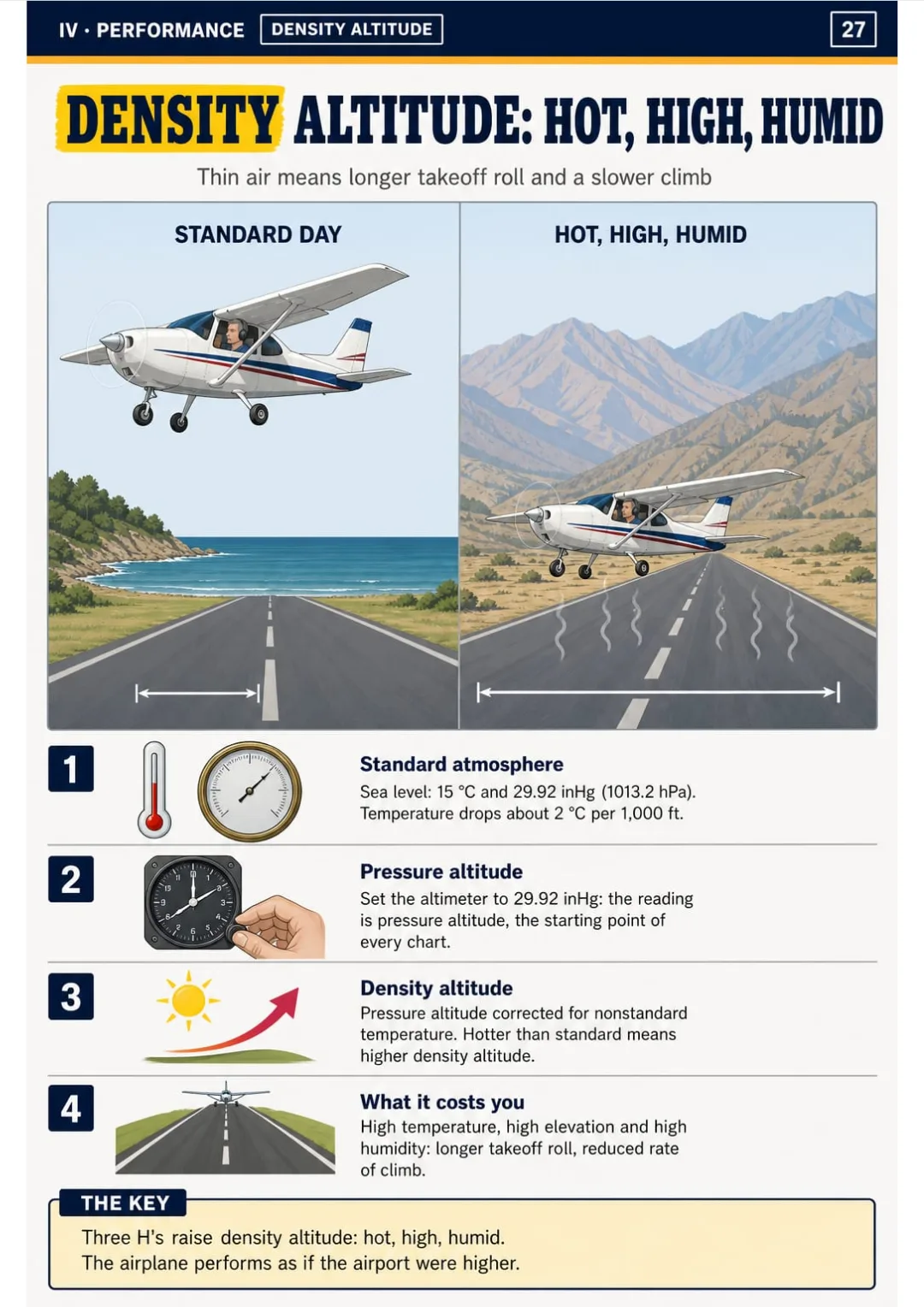
Standard day: 15 °C and 29.92 inHg at sea level, about 2 °C cooler per 1,000 ft
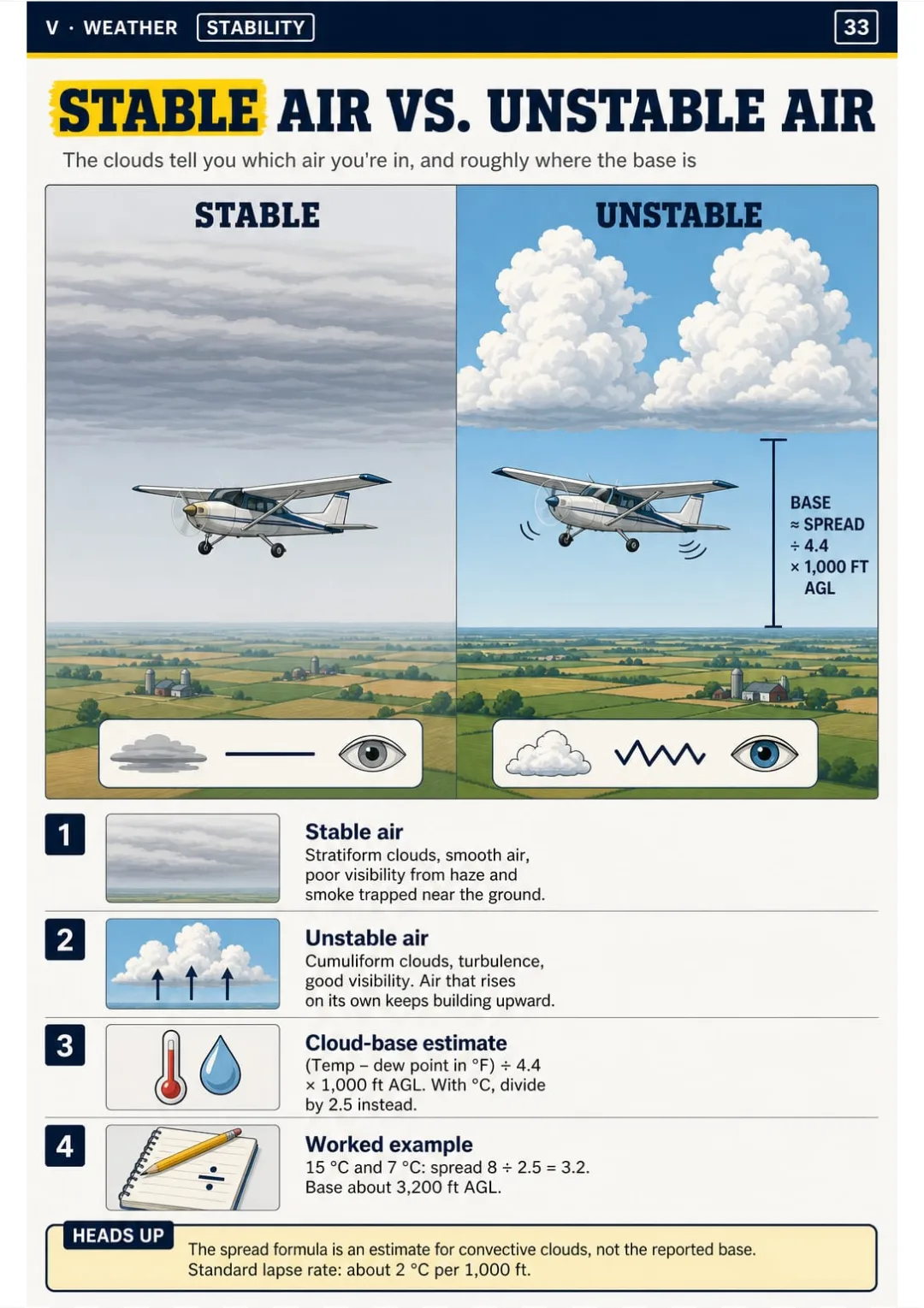
Cloud base ≈ (temp − dew point °F) ÷ 4.4 × 1,000 ft AGL
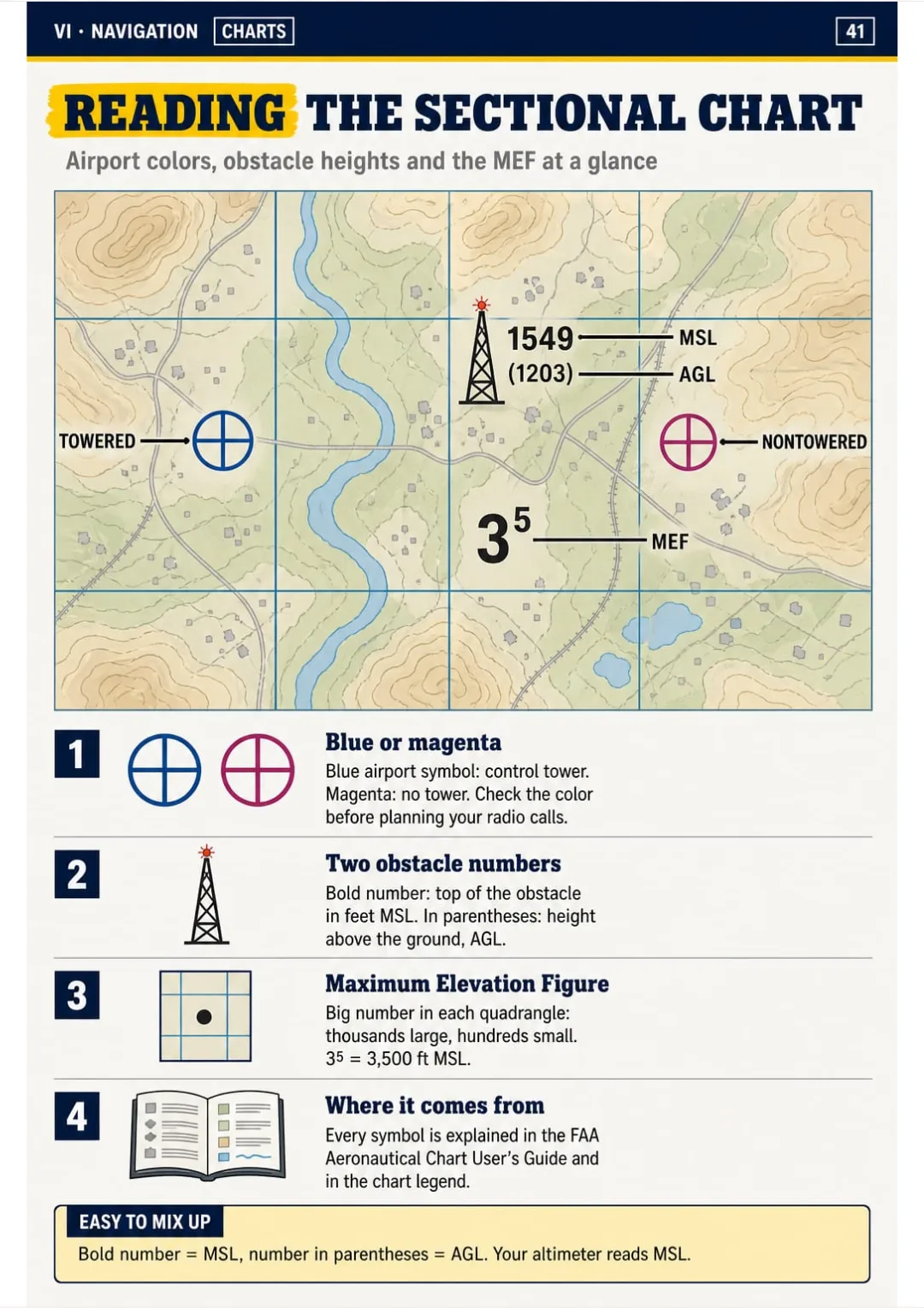
Obstacle 1549 (1203): 1,549 ft MSL, 1,203 ft above the ground
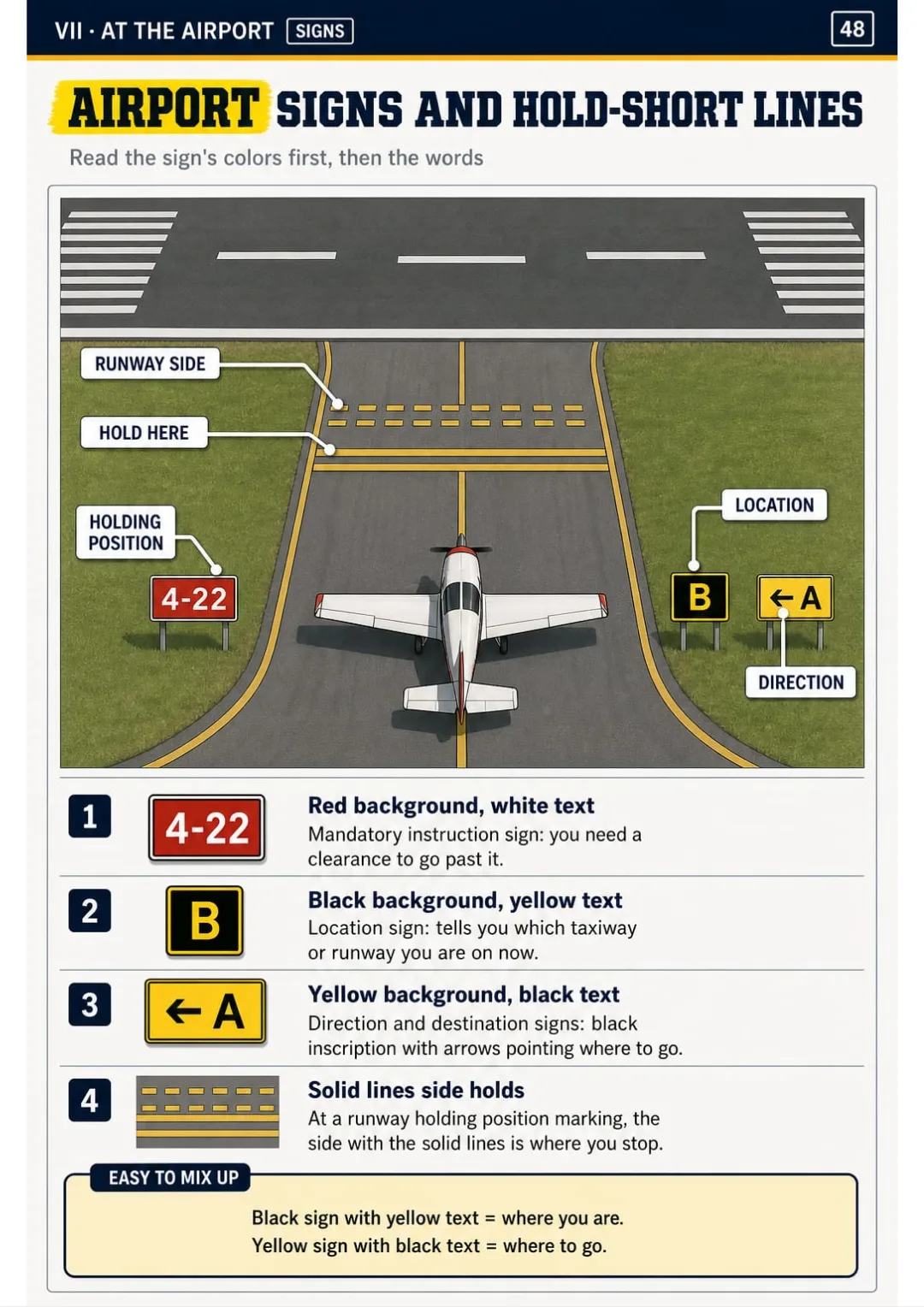
Red = mandatory, black = you are here, yellow = direction; hold on the solid-line side.
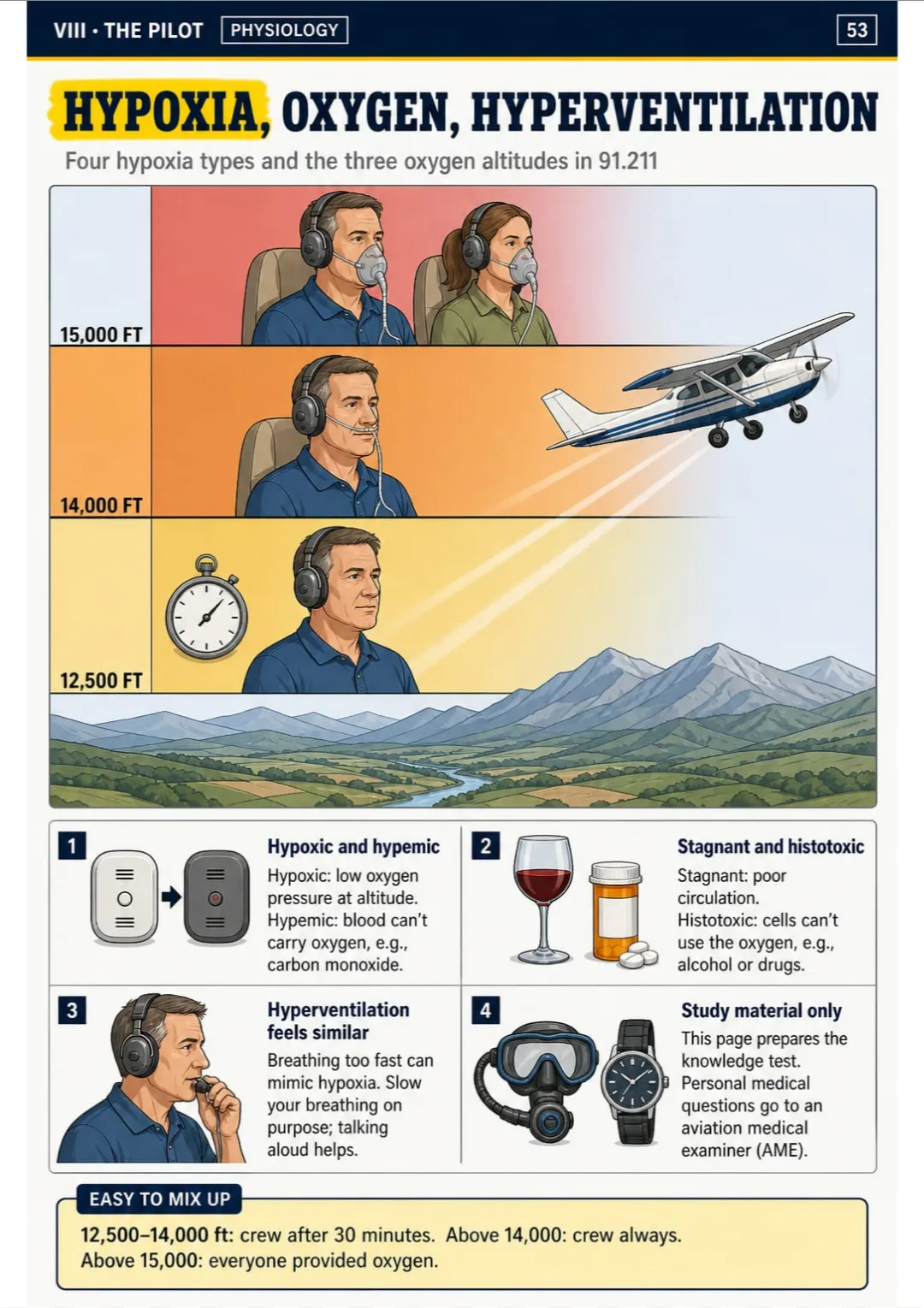
91.211: crew oxygen after 30 min above 12,500 ft, always above 14,000; provided to everyone above 15,000.

These are real pages from the book. The table of contents is the full one: 9 parts and 55 topics.

Stall speed is a number on the dial; the stall itself is an angle.

Saturday ground briefing: your instructor asks if a wing can stall at cruise speed

You're at the table before the flight, sectional folded. Your CFI looks up and asks: can a wing stall at any airspeed and in any attitude?

You say no, then hesitate. Last night's reading put stall speed, load factor and angle of attack in the same few pages, and they ran together. On test day there is no CFI to nudge you: the question lands and you either recognize the page or you guess.

The page shows the four forces around one airplane and a wing tilting past its critical angle. The box spells out the rule: a wing stalls past the critical angle of attack, at any airspeed, attitude or power setting.

Lift, weight, thrust, drag, and the critical angle where a wing stalls
Exam traps

Spot the trap before the test does

Every page ends with a note box like these: the mix-up the exam counts on.

DENSITY ALTITUDE: HOT, HIGH, HUMID
p. 27 · DENSITY ALTITUDE: HOT, HIGH, HUMIDTHE KEY

Three H's raise density altitude: hot, high, humid. The airplane performs as if the airport were higher.

READING THE SECTIONAL CHART
p. 41 · READING THE SECTIONAL CHARTEASY TO MIX UP

Bold number = MSL, number in parentheses = AGL. Your altimeter reads MSL.

AIRPORT SIGNS AND HOLD-SHORT LINES
p. 48 · AIRPORT SIGNS AND HOLD-SHORT LINESEASY TO MIX UP

Black sign with yellow text = where you are. Yellow sign with black text = where to go.

HYPOXIA, OXYGEN, HYPERVENTILATION
p. 53 · HYPOXIA, OXYGEN, HYPERVENTILATIONEASY TO MIX UP

12,500–14,000 ft: crew after 30 minutes. Above 14,000: crew always. Above 15,000: everyone provided oxygen.

Price US$ 27 US$ 63

I want these pages
What you'll see

All the content, part by part

From the rules a private pilot flies under, through airspace, the airplane, performance, weather and navigation, to the airport, the pilot's own limits and test day, in the order you'd use them on a real flight.

I

The Rules You Fly Under

pp. 5-11
  • What a Private Pilot May and May Not Do
  • Medical Certificates and BasicMed
  • Flight Review and Passenger Currency
  • ARROW: The Documents on Board
  • Inspections: Who Is Due When
  • Required Equipment and Inop Items
  • Alcohol, Fuel Reserves and Accident Reports
II

Airspace

pp. 12-18
  • The Airspace Stack at a Glance
  • Class B: The Upside-Down Wedding Cake
  • Class C: Two Rings and a Radio Call
  • Class D: The Towered Airport
  • Class E: Where It Starts
  • VFR Weather Minimums: The Whole Table
  • Special Use Airspace, TFRs and Cruising Altitudes
III

The Airplane

pp. 19-26
  • Four Forces and the Critical Angle of Attack
  • Left-Turning Tendencies
  • Load Factor and Stall Speed in a Turn
  • Engine, Mixture and Carburetor Ice
  • Fuel Grades and Fuel System
  • The Pitot-Static System and Its Failures
  • Gyro Instruments and the Magnetic Compass
  • Airspeed Markings and the Five Altitudes
IV

Performance and Weight and Balance

pp. 27-32
  • Density Altitude: Hot, High, Humid
  • Reading Takeoff and Landing Charts
  • Weight × Arm = Moment
  • The CG Envelope and Weight Shift
  • Crosswind Component Chart
  • Ground Effect and Wake Turbulence
V

Weather

pp. 33-40
  • Stability, Clouds and the Cloud-Base Estimate
  • Air Masses and Fronts
  • Thunderstorms and Icing
  • Fog and Wind Shear
  • Decoding a METAR
  • Decoding a TAF
  • Winds and Temperatures Aloft
  • PIREPs, AIRMETs and SIGMETs
VI

Navigation

pp. 41-47
  • Sectional Chart Symbols
  • The Airport Data Block
  • True to Compass: East Is Least, West Is Best
  • Wind Triangle and Groundspeed
  • Time, Distance and Fuel
  • VOR: Radials, TO/FROM and the CDI
  • GPS, Dead Reckoning and Getting Lost
VII

At the Airport

pp. 48-52
  • Runway Markings and Airport Signs
  • Airport Lighting, VASI and PAPI
  • The Traffic Pattern
  • Light Gun Signals
  • Radio, Transponder Codes and Right of Way
VIII

The Pilot

pp. 53-56
  • Hypoxia, Oxygen and Hyperventilation
  • Spatial Disorientation and Landing Illusions
  • Five Hazardous Attitudes and Their Antidotes
  • IMSAFE, PAVE and DECIDE
IX

Exam Day

pp. 57-59
  • The Knowledge Test: Format and Rules
  • Your Test Report and ACS Codes
  • Frequent Mix-Ups: The Final Checklist

At the end of the book: A note box on every topic page, the FAA source next to each critical number and a final checklist of frequent mix-ups

A different way to learn

Stop rereading the whole chapter to find one altitude

A text manual
  • You reread the airspace chapter hunting for the one altitude you need.
  • You memorize the VFR minimums table as rows of digits.
  • You ask another student which class needs a clearance and which needs a radio call.
Class A from 18,000 ft MSL to FL600, Class E filling the rest of controlled airspace and above FL600, Class G underneath.
This book
  • The airspace stack is one drawing, from the ground to FL600, with every class labeled.
  • Each minimum sits next to its class, with the regulation that sets it.
  • Each class page lists what you need before entering: clearance, two-way radio, transponder.

Who it's for

I'm just starting

I'm just starting

You've had a few lessons and the Pilot's Handbook feels huge. The book opens with what a private pilot may do, like sharing flight costs while paying at least your pro rata share, and builds from there.

I'm flying, but the theory is scattered

I'm flying, but the theory is scattered

You can land the airplane, yet airspace and weather still blur together. The airspace stack and METAR pages put each piece back in the same order every time you review.
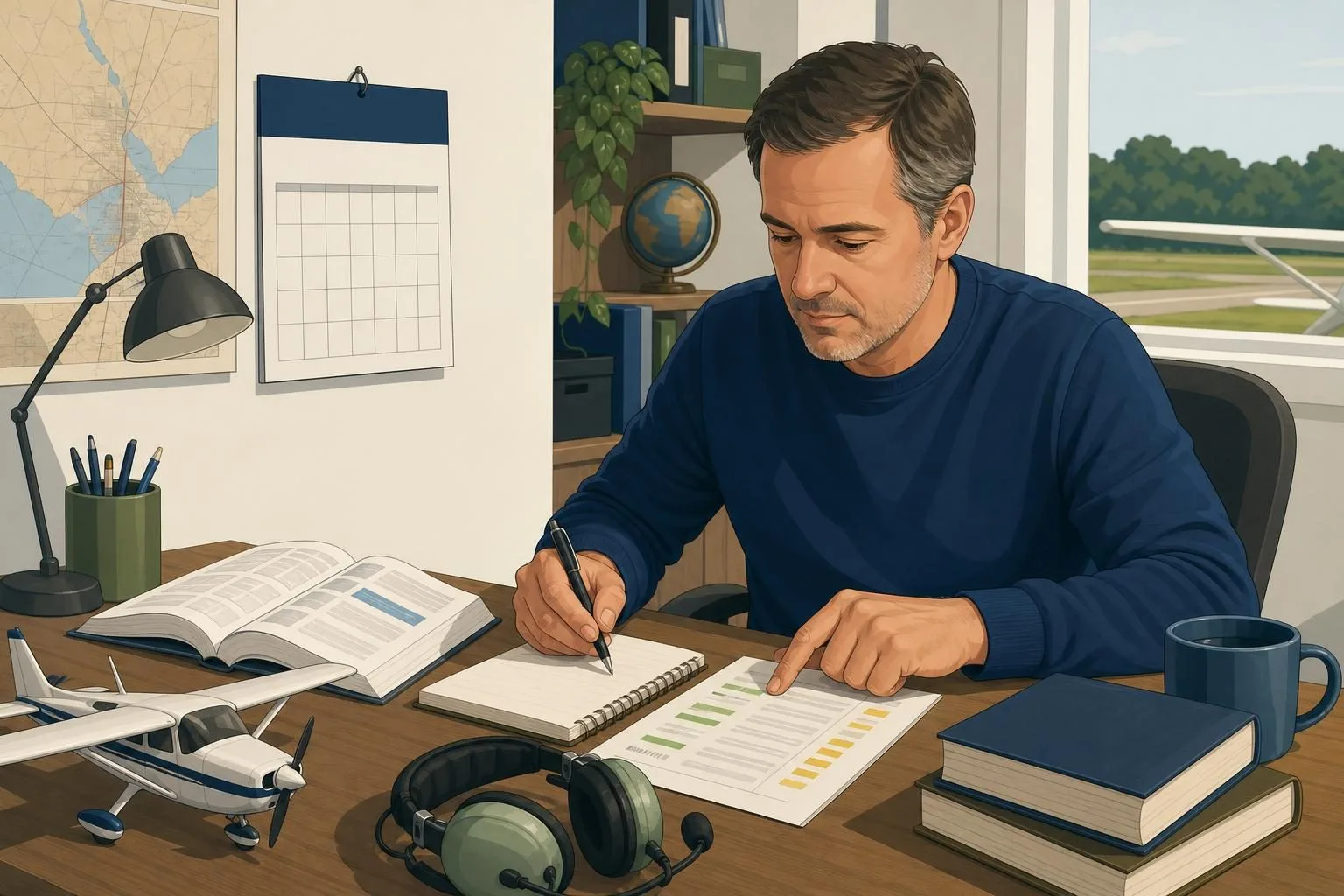
My written is on the calendar

My written is on the calendar

You want to check every subject area before test day. The Practice Questions point each answer back to its page, and the final checklist lists the frequent mix-ups.

Price US$ 27 US$ 63
I want the PDF book

Private Pilot: The Written Exam + 2 bonus books

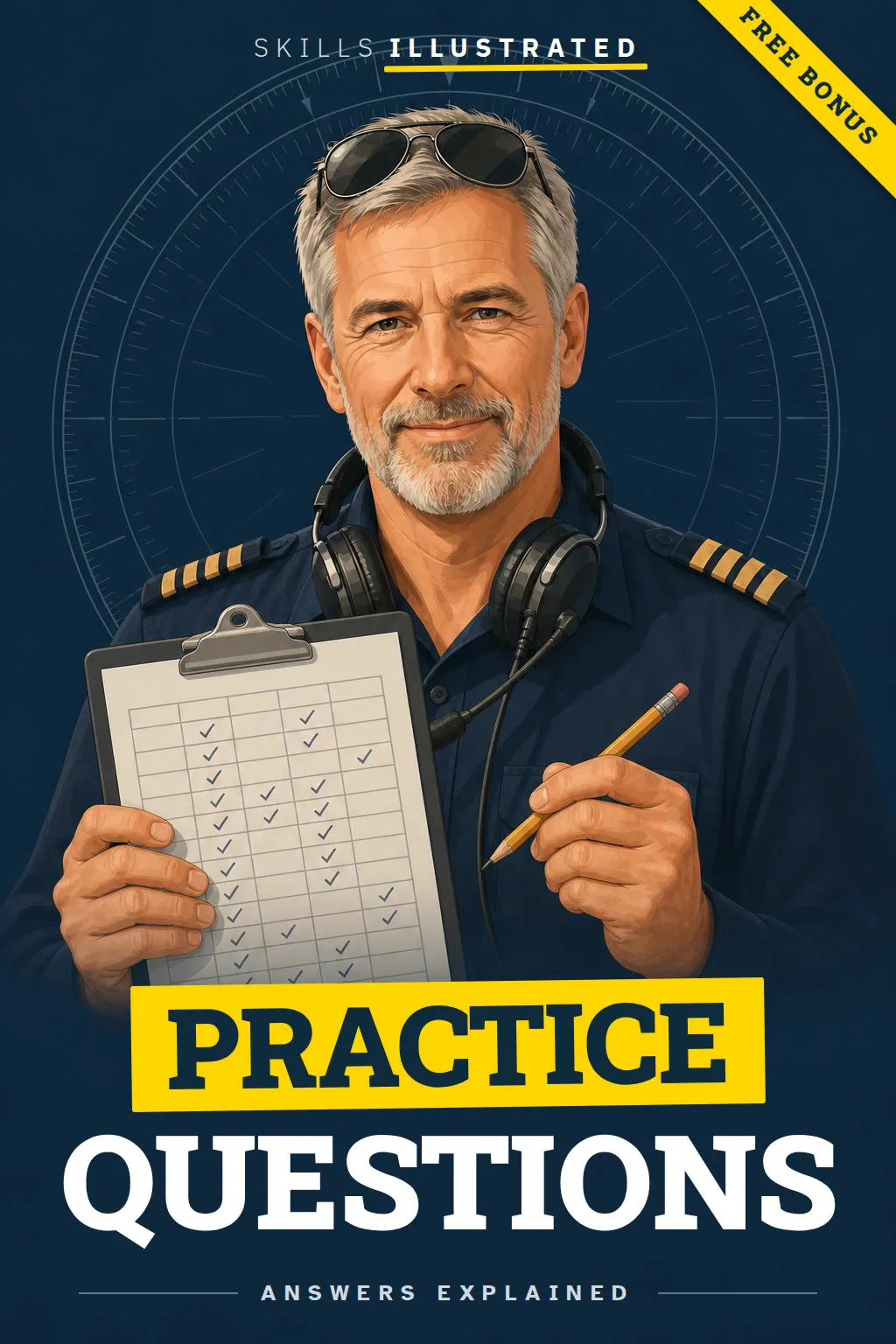
Bonus 1Practice Questions

«Practice Questions»

Check yourself topic by topic with knowledge-test-style questions, each answer explained and pointed back to the page that covers it.

US$ 17.90 FREE
Bonus 2Airspace Cheat Sheet

«Airspace Cheat Sheet»

Every airspace class, its entry requirements and VFR weather minimums on charts you can read at a glance, ready to print and keep in your flight bag.

US$ 14.90 FREE

Private Pilot: The Written Exam + 2 bonus books

  • Private Pilot: The Written Exam: 59 pages in 9 partsUS$ 63
  • Bonus 1: «Practice Questions»US$ 17.90
  • Bonus 2: «Airspace Cheat Sheet»US$ 14.90
  • High-resolution PDF to printIncluded
Total value US$ 95.80US$ 27You save US$ 68.80
I want Private Pilot: The Written Exam for US$ 27

📄 This is a digital PDF book sent to your email: nothing is printed or shipped.

  • Secure purchase
  • Encrypted payment
  • 30-day guarantee

PDF by email: We email you Private Pilot: The Written Exam as a PDF, together with the two free books. It's a single payment: no installments, no extra charges.

30DAYS

30-Day Guarantee

Try Private Pilot: The Written Exam for 30 days, bonus books included.

We refund everything if the file won't open, if the book isn't what you see here, if you were charged twice or if the email doesn't arrive. Just email us.

You pay once. No subscriptions.

What people ask most

How do I receive it?

As PDFs by email: the book and both gifts. It's not a printed book; you can read it on your phone, tablet or computer, or print the pages you want.

Is it a one-time payment?

Yes. You pay once, with no subscription. METARs, TAFs and weight and balance are already in the book, and both gifts are included. The extras offered at checkout are optional, with more worked examples.

Does it replace my CFI or a ground school?

No. It's study material for the written exam. It doesn't replace instruction with a certificated flight instructor, doesn't give you an endorsement and doesn't authorize you to fly.

Where do the numbers come from?

From FAA sources: 14 CFR Parts 61 and 91, the AIM, the Pilot's Handbook of Aeronautical Knowledge, the Airplane Flying Handbook, the Aeronautical Chart User's Guide and the Aviation Weather Handbook. Each critical number cites its source. Where a value can change, the page says 'per the current regulation' so you know to check it.

I already have the free Pilot's Handbook and a question app. What does this add?

The handbook explains everything at length, and the app tests you. This book sits between them: you see the drawing, the note box and the FAA source together, in the same nine-part order every time you review.

Is it for the US private pilot airplane test?

Yes. It follows the FAA Private Pilot Airplane knowledge test and the current Airman Certification Standards, with US airspace, charts and units. In 59 pages it covers every subject area as a visual review: the Pilot's Handbook stays your full reference, and this is the book you go back to before a lesson or the test.

Can I print it?

Yes. It's a PDF, so you can print any page you like. The Airspace Cheat Sheet is laid out to keep in your flight bag.

How does the refund work?

You have 30 days. We refund everything if the file won't open, if the book isn't what you see on this page, if you were charged twice or if the email doesn't arrive: just email us.

It's a PDF: read it on screen or print it

One book, one page per topic and 30 days to try it.

Start with the first page.

One-time payment: US$ 27 · Guarantee: 30 days · PDF by email

I want Private Pilot: The Written Exam for US$ 27

📄 This is a digital PDF book sent to your email: nothing is printed or shipped.

US$ 27Get it